
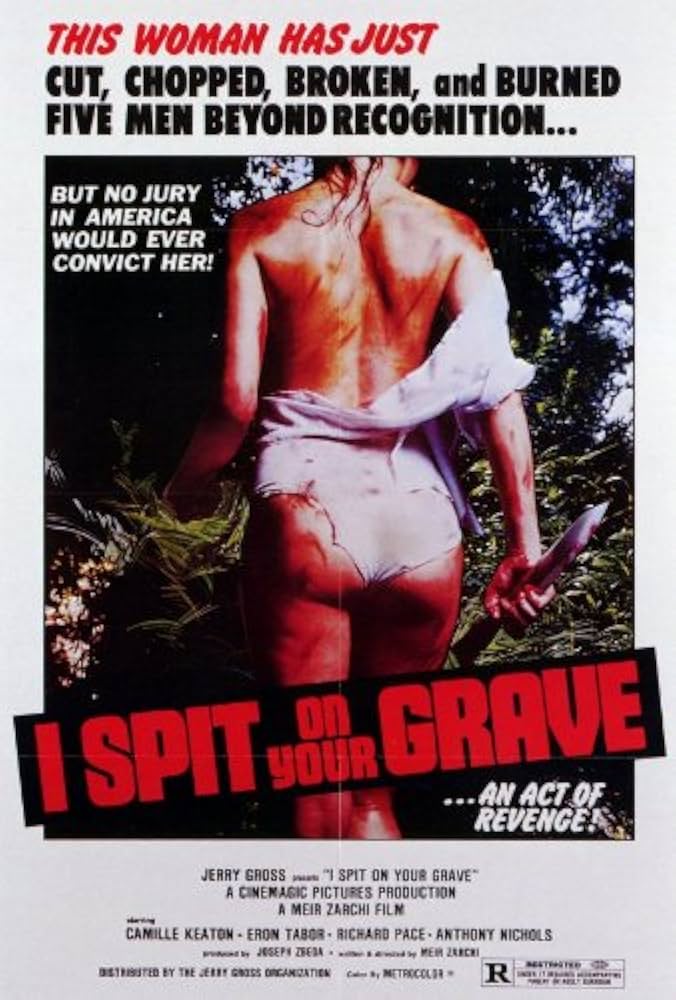
“This movie is an expression of the most diseased and perverted darker human natures, Because it is made artlessly, It flaunts its motives: There is no reason to see this movie except to be entertained by the sight of sadism and suffering. As a critic, I have never condemned the use of violence in films if I felt the filmmakers had an artistic reason for employing it. “I Spit on Your Grave” does not. It is a geek show. I wonder if its exhibitors saw it before they decided to play it, and if they felt as unclean afterward as I did.” - Roger Ebert
Originally titled Day of the Woman, Meir Zarchi’s I Spit on Your Grave (1978) is perhaps the most infamous and graphic entry into the rape-revenge sub-genre. The film follows city woman Jennifer Hills as she travels to the country for a cabin stay, where she can write her book in seclusion. After four local men brutally rape her, Jennifer violently and seductively exacts her revenge.
I Spit on Your Grave has a distinct ability to divide audiences for its extreme portrayal of sexual violence. Jennifer first encounters her rapists—Johnny, Andy, and Stanley—at a gas station, and meets Matthew when he delivers her groceries. Johnny is the first to rape her, and two additional rape sequences ensue. Though the scenes are shockingly vicious with Jennifer’s dirty, bloody, languished body and the perpetrators in frame, the film leans into erotic elements that do little to tackle larger institutional failures or explore Jennifer’s trauma beyond revenge alone. Even then, Jennifer’s retribution is crafted into an erotic spectacle, touching Johnny while nude in a bathtub before castrating him and even going as far as to depict her having sex with Matthew before she slips a noose around his neck. As such, the retribution’s construction panders to a straight male audience and clouds understandings of trauma, which complicates feminist readings. Roger Ebert was clearly not a fan.
It is difficult to contend with the film’s excessive rape sequences and unabashed brutality, but the film does provide insight into masculine gender dynamics. Matthew, who is a neurodivergent individual, is often played for laughs and is frequently mocked by the other men. Throughout the film, they taunt him with remarks including “Broads don’t turn him on” and “Wanna be a man, don’t cha?” to convince him to violate Jennifer. These statements frame masculinity as something that must be proven through sexual aggression, pressuring him to conform to their distorted behavioral standards for their own satisfaction. In this sense, the men’s violence is depicted as being socially enforced through humiliation and peer surveillance. This group dynamic is a key feature within the film. During rape sequences, tight framing centers the men watching their peers in the act, appearing to derive pleasure from their shared offense and spectatorship. I explore homosociality in gang rape scenarios in more detail in the Promising Young Woman (2020) section.
While I struggle to perceive I Spit on Your Grave as a truly feminist film, the piece does briefly touch on victim-blaming rape culture. When Jennifer confronts Johnny, forcing him to strip at gunpoint, he says:
You coax a man into doing it to you, and a man gets the message fast. Now look, whether he's married or not, a man is just a man. Hey, first thing you come to the gas station and you expose your damn sexy legs to me, walking back and forth real slow, making sure I see 'em good. And then Matthew delivers the food to your door. Come on, he sees half of your tits peeking out at him. Tits with no bra. And then you're lying in the canoe in your bikini, just waiting, like bait. (I Spit on Your Grave 1:21:50-1:22:30)
Johnny’s monologue wrongfully characterizes Jennifer as being saturated with sexual appeal, implying her aesthetic presentation and behavior were intentionally crafted to attract him. This is similar to victim-blaming language that suggests a woman would have been protected from assault had she dressed or acted differently. Further, when stating that “a man is just a man,” his messaging is similar to remarks expressing that “boys will be boys.” This terminology naturalizes men’s harmful behavior, shifting blame and absolving them from necessary accountability.
In the 1970s, legal systems often required victims to prove they physically resisted, placing the burden of guilt on the survivor, and women were blamed for "asking for it" based on their clothing, behavior, or consumption of substances. In response, women, often survivors themselves, founded rape crisis centers to provide support to those in need (“What are Rape Crisis Centers and how have they changed over the years?”). The stigma associated with rape persists into the twenty-first century, with activists vocalizing the need for change. In 2011, SlutWalk emerged as a transnational movement as a direct response to widespread victim-blaming and slut-shaming of survivors. Participants reclaim the derogatory language used against survivors and challenge the harmful narratives that shift responsibility away from perpetrators. Marching in cities across the globe, activists have continued to demand accountability, promote consent education, and work to dismantle the enduring stigma surrounding sexual violence.

Released in 2010, Steven R. Monroe’s remake of I Spit on Your Grave (2010) follows Zarchi’s general storyline. Jennifer Hills leaves New York City for rural Louisiana to develop her book, where the group of men she encounters at a gas station breaks into her home, brutally violates her, and returns later to assault her again. This remake, however, makes significant changes to the perpetrators and Jennifer’s revenge plot.
In I Spit on Your Grave (2010), Monroe removes the revenge plot’s eroticized elements that defined Zarchi’s film, instead emphasizing punitive violence. However, assault scenes remain gratuitous. A significant portion of the runtime showcases the men as they video record, taunt, and terrorize Jennifer in her cabin. Like Zarchi’s protagonist, she is assaulted twice and nearly drowned. In the wake of the violence, she enacts a Saw-like form of retribution: elaborate, torturous, and calculated. Her ‘traps’ correspond with the treatment she endured, mirroring their abuse to invert victim-perpetrator power relations. She captures Matthew to stage a final shotgun trap that kills the sheriff, sews Andy’s eyes open for birds to peck out, and drowns Stanley in a lye bath. Then, in an homage to the original, Jennifer castrates Johnny as he hangs from the ceiling. Altogether, the film amplifies the retributive acts present in the original. Though the extended abuse and assault sequences are difficult to overlook, Jennifer’s revenge plots can be read as a form of empowerment. There is satisfaction in witnessing these rapists’ comeuppance, and viewers are positioned to identify with Jennifer’s rage and ingenuity.
It is important to note that the film’s inclusion of law enforcement is a small but relevant revision. After the perpetrators from the gas station break into her cabin, she runs through the woods, where she encounters Sheriff Storch. At first appearing as a benevolent cop, his questions shift to a victim-blaming interrogation as he calls attention to her drinking and substance use. His true intentions are clear when he himself welcomes the original perpetrators into her home and later becomes a participant in her second assault. Similar to The Last House on the Left, the small-town sheriff himself is perhaps the most malevolent force, a symbol of a larger, corrupt system.
Still, like The House on the Left and the Zarchi’s original, it is by no means a “good” film. The alterations made to the film’s revenge structure are done in the service of exacerbating the violence’s impact. Little attention is given to the assaults’ physical or psychological aftermath. In both instances, Jennifer’s character arc remains constrained; she is merely a vehicle for the revenge’s execution. She has been deliberately crafted to deliver a violent and erotic spectacle. With that said, I would be remiss not to acknowledge the films’ cathartic abilities for survivors. Despite often being perceived as appealing primarily to male audiences, large numbers of women and survivors view and enjoy this content. Seeing such dramatic acts of retributive violence play out on screen can feel liberatory. However, this catharsis is not without tension. At some point amidst Jennifer’s barbaric rape and near-pornographic revenge, a social critique begins to fracture, or, at the very least, become a bit unstable. While Jennifer’s body is almost always in full view, it is important to consider how and why her personhood may remain obscured.