
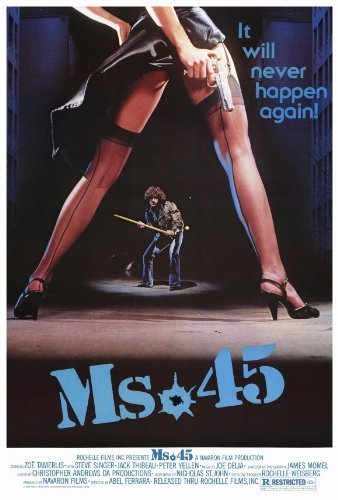
Abel Ferrara’s Ms .45 (1981), originally titled Angel of Vengeance, follows Thana, a mute seamstress in New York City’s garment district. Walking home after her shift, she is raped at gunpoint in an alleyway. When she returns to her apartment, a burglar assaults her a second time before she bludgeons him to death and later dismembers him to dispose of his body. Keeping her second attacker’s .45 caliber pistol, Thana assumes the identity of a cloaked vigilante, murdering a man on the street, an arrogant fashion photographer, a pimp who assaults a sex worker, several members of a gang seeking to sexually assault her, and a businessman and his limousine driver. Her final act of violence occurs at her workplace’s Halloween party, where she murders her boss, who inappropriately attempts to seduce her, before she herself is killed.
Thana’s narrative is a bleak meditation on trauma and injustice with a hint of 80s flair. For example, after her second assault, Thana hallucinates a man touching her breast as she showers. When she returns to work the following day, her unease and fear are palpable. To Thana, nearly all men are considered a potential threat she must eradicate for herself and for other women. As Carol Clover writes in her 1992 book Men, Women, and Chain Saws: Gender in the Modern Horror Film, “Thana takes revenge not only for her own literal rape but for the figurative rape of all women” (Clover 144). At first, she targets men who accost her, but as the film progresses, she leaves her home at night with the explicit intention of seeking out individuals to murder—even undergoing a physical transformation where she dons red lipstick and a striking leather ensemble. As with the pimp and prostitute, she functions as a ‘savior’ for women, transforming into a symbol of vengeance in both aesthetic and action.
However, the film’s conclusion complicates the notions of sisterhood. After she murders her boss, Thana begins a shooting spree, primarily targeting the men present. Then, her co-worker Laurie picks up a nearby knife and stabs Thana in the back. Thana swiftly turns to face Laurie and aims her gun, but hesitates; she screams out "Sister!" before she falls to the ground and dies. This is the only time Thana speaks during the film. In her last breath, she appears to express her shock at being murdered by the very people she was attempting to protect. This physical backstabbing could signify how Thana’s trauma and rage are misunderstood, even by those who could potentially sympathize with her. Rather than achieving catharsis through her revenge plot, her death speaks to women’s denial of justice and the breakdown of solidarity between women in a patriarchal society.
Ms .45 was the first film on the list to acknowledge the trauma survivors may experience, as well as capture the fear many women experience daily as a result of rape culture. The film also connects to modern feminist discourse in its inclusion of workplace sexual harassment. Thana’s boss attempts to seduce her, touching her without consent and pressuring her to accompany him to the workplace Halloween party. His actions are inappropriate, violating her bodily autonomy and the workplace’s professional boundaries. Thana’s experience reflects that of women across the country. A 2019 study found that thirty-eight percent of all women and fourteen percent of men have reported experiencing sexual harassment at work, and 1 in 7 women and 1 in 17 men have sought a new job assignment, changed jobs, or quit a job because of sexual harassment and assault (Kearl, Johns, & Raj, 2019 and Kearl et al., 2019). Aside from his eventual murder, the film does little to directly challenge these dynamics, subsuming them into its broader frame of individualized revenge. Nevertheless, its depiction of workplace harassment is a meaningful inclusion that gestures toward a broader social reality, alluding to systemic issues we continue to wrestle with today.